Hiring can either protect EBITDA or weaken it quickly.
As a company grows, the amount of work across the business grows with it. Teams handle more clients, more projects, and more operational tasks. At that point, adding people often feels like the logical next step.
Yet hiring always brings a financial trade-off. A new employee shows up on the expense line right away, while the revenue that hire helps generate usually takes time to appear.
2025 data from the U.S. Bureau of Labor Statistics shows that private employers paid an average of $32.37 per hour in wages and salaries and another $13.68 per hour in benefits, which means the cost of hiring is significantly higher than the base pay alone.
This article breaks down how hiring decisions directly affect EBITDA, where companies often get it wrong, and how leaders can add capacity in a way that supports growth while keeping profitability intact.
Clear hiring plans protect EBITDA before costs hit the P&L.
Why EBITDA Drops Before a New Hire Produces Results
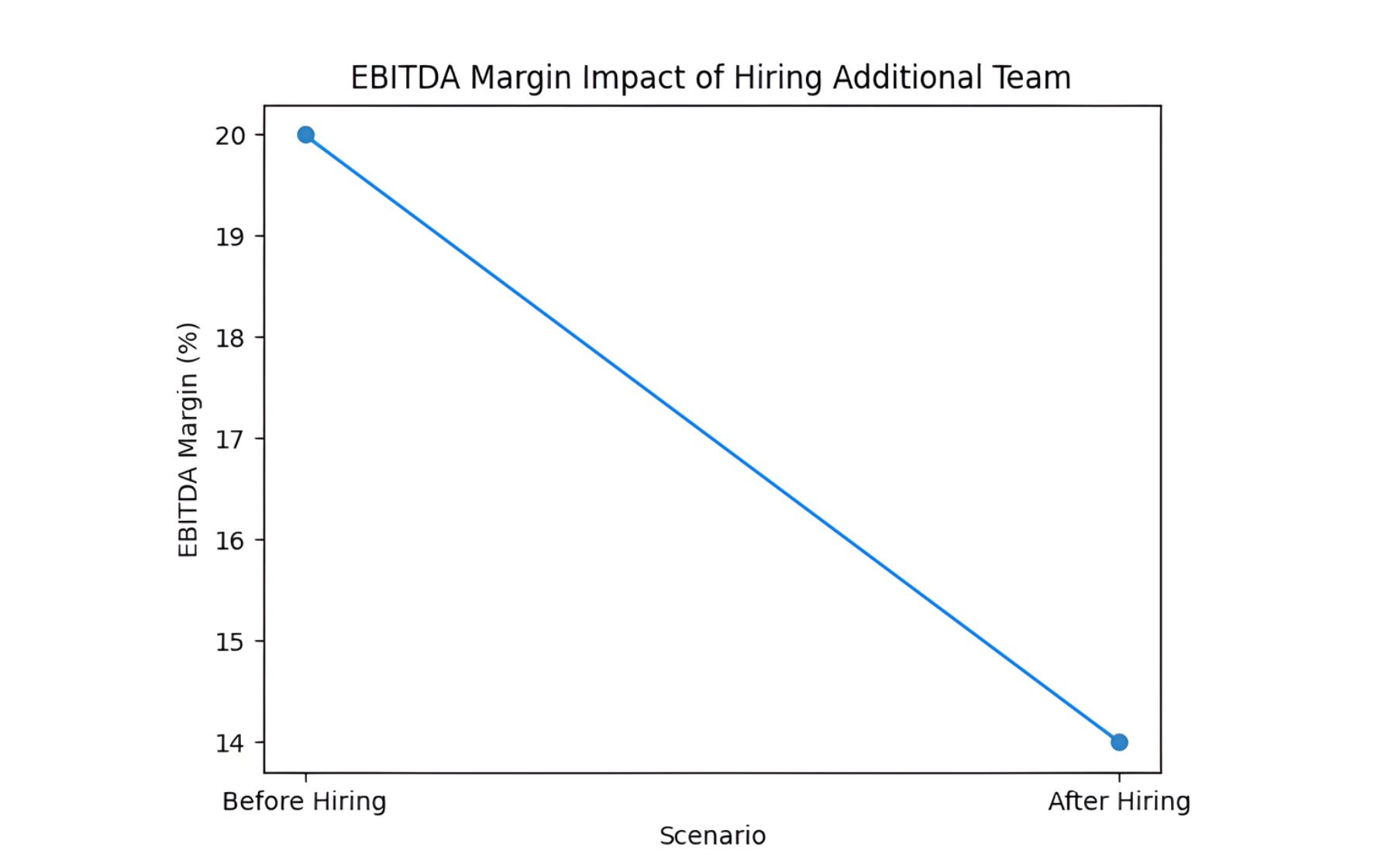
A business generating $10 million in revenue with $2 million in EBITDA operates at a 20% margin. Add a five-person operations team costing $600,000 annually and EBITDA drops to $1.4 million the moment those salaries start. Margin slides from 20% to 14% long before the team contributes additional revenue.
This is not an EBITDA trend that makes leadership feel comfortable
The mistake appears in companies that hire for anticipated growth rather than operational bottlenecks. Sales leaders hire pipeline staff before lead volume exists. Operations leaders add management layers before delivery volume expands. Marketing teams recruit specialists before demand generation systems mature.
In many cases, the issue is not the quality of the hires. The challenge lies in timing. Capacity arrives before the business has enough activity to justify the cost.
Leadership usually sees the consequences during financial reviews. Margins tighten, spending decisions become more cautious, and growth plans pause while the organization absorbs the added payroll. One large hiring wave can reduce EBITDA for several quarters before revenue catches up.
Why the Wrong Hire Usually Sits Too High in the Org Chart
A significant amount of margin erosion happens because senior employees handle work that does not require senior expertise.
A recruiter spending hours sourcing candidates.
A finance lead following up on invoice approvals.
A project manager updating status spreadsheets.
A senior executive coordinating meeting logistics.
“Move the research work to an operational support layer and those same recruiters can manage 36 searches annually”
These activities gradually drain EBITDA. Companies end up paying high salaries for work that could be completed by someone operating at a different cost structure.
Consider a recruiting firm handling 24 executive searches per year. Recruiters often divide their time between interviewing candidates and building research lists. Move the research work to an operational support layer and those same recruiters can manage 36 searches annually. The revenue capacity of the team increases without adding another senior recruiter.
The change may appear small at first, yet the result becomes clear over time. The organization stops using premium salaries for operational tasks and instead directs those salaries toward decision-making, relationship building, and revenue generation.
Can Under-hiring Negatively Impact EBITDA?
Leaders often believe conservative hiring protects profitability. In practice, excessive caution creates operational bottlenecks.
Teams become overloaded.
Response times increase.
Client onboarding takes longer.
Sales opportunities slow down while staff juggle delivery work.
Managers begin covering operational gaps instead of focusing on strategy.
These problems do not appear on a financial dashboard labeled “under-hiring.” Instead, they surface through delayed revenue, declining client satisfaction, and exhausted teams.
For example, a consulting firm that delays hiring operations support might preserve margin for one quarter. The following quarter can reveal the cost: delayed project launches, slower billing cycles, and fewer engagements secured.
In these situations, EBITDA declines through missed opportunities rather than through visible payroll expenses.
Every hire is a margin decision - choose roles that drive revenue, not just headcount.
How Can I Hire to Scale Operations And Preserve EBITDA?
Staged Hiring
A lot of leadership teams avoid two costly extremes: freezing hiring entirely or expanding headcount too quickly.
A practical approach is to connect hiring decisions to clear business milestones.
Instead of adding roles based on assumptions, companies introduce new hires after the business reaches specific revenue levels or operational thresholds.
Examples appear across scaling companies:
Revenue milestone → hire trigger
$5M in annual revenue → first dedicated sales representative
$7M in annual revenue → sales manager
$10M in annual revenue → operations director
$15M in annual revenue → vice president of sales
This approach protects EBITDA because hiring follows proven demand rather than projections.
Leadership teams also monitor revenue per employee, a metric that helps determine whether a company is scaling efficiently.
The metric simply divides total revenue by the number of employees in the organization. It helps leaders see whether the workforce is producing enough output relative to its cost.
Typical benchmarks vary by industry:
Professional services: $200,000–$400,000 revenue per employee
Software companies: $250,000–$500,000 revenue per employee
Agencies: $150,000–$250,000 revenue per employee
If revenue per employee drops quickly, headcount is increasing faster than the business is generating revenue.
EBITA follows when the right work sits with the right person
An Execution Layer with Trained Virtual Assistants
Using trained virtual assistants as an execution layer to delegate tasks to will increase productivity without bloating payroll. Many companies assume growth requires additional senior staff. Often, the requirement is operational execution.
Senior professionals deliver the highest value when they focus on specialized work:
Attorneys advising clients
Recruiters closing candidates
Executives negotiating partnerships
Finance leaders managing capital allocation
Operational work surrounding those activities still needs to happen:
Research
Reporting
Scheduling
Documentation
Data preparation
A trained assistant working at the execution layer can handle those tasks at a fraction of the cost of a full-time employee. This allows your leadership and management to focus on strategy and billable hours.
Here are a few examples of how an assistant or virtual team can fit into an organization, be delegated work, and improve efficiency:
A legal team can assemble case research packets before attorneys review them.
A recruiting firm can prepare candidate research lists before interviews begin.
A construction company can organize permitting documents before executive approval.
This structure multiplies the productivity of senior professionals. Specialists concentrate on judgment and revenue-producing work while operational teams maintain workflow continuity.
What Metrics Can a Business Leader Use to Evaluate Hiring?
Leaders typically evaluate four key metrics before approving a new role:
Revenue per employee This metric indicates whether workforce expansion matches revenue growth.
EBITDA margin protection This estimates how margins may change after salary, benefits, and related employment costs are added.
Senior time recovered This measures how much leadership time the role frees so executives and specialists can focus on strategy and revenue-generating work.
Time to revenue or capacity increase This evaluates how quickly the role helps the organization generate revenue or expand operational capacity.
A hire that removes operational bottlenecks, supports revenue-generating activities, or allows teams to handle more work without overloading senior staff can protect EBITDA far better than delaying the decision.
Conclusion
Efficient hiring does not mean hiring less. It means hiring precisely.
Organizations that grow successfully treat hiring as part of their operating system rather than as a reaction to mounting workload. They protect specialist time, introduce operational support where execution begins to slow, and expand the workforce in stages alongside revenue growth. This where offshore assistants can be a force multiplier; getting more done while spending less on recruitment and staffing.
This discipline allows the business to grow while keeping payroll in line with profitability – the balance EBITDA was designed to measure.
Masterclass: Optimize your people strategy for growth