A clear marketing team structure performs better at delivering measurable business outcomes, such as revenue growth and customer engagement.
A recent study found that 42% of marketing leaders with robust operating models see a direct link between marketing activity and overall business performance – reinforcing the value of marketing department structure, disciplined workflows, and focused marketing spend.
Below, you’ll learn what modern marketing team structures look like, and how you can build one that supports your goals.
Effective marketing teams focus on shared tasks, not just titles
Benefits of Developing a Good Marketing Team Structure
Team design influences how marketing work gets planned, coordinated, executed, and improved over time.
Better coordination across initiatives: It becomes easier to sequence campaign activities, manage specific projects, and reduce confusion about who does what.
Easier tracking of results: With defined roles, you can link effort to outcomes and decide where to allocate resources.
Faster onboarding of new team members: Clear roles and expectations reduce the time new hires need before they contribute.
Improved consistency across marketing outputs: Teams can protect brand voice and brand consistency across content, campaigns, and marketing collateral.
Enhanced adaptability to change: Teams adjust more effectively to changes in the competitive landscape, new channels, or evolving customer behavior.
Types of Marketing Team Structures
Marketing teams organize themselves in different ways depending on company needs, market segments, channels, and strategic focus.
Functional Marketing Team Structure
Responsibilities are grouped by specialty so each channel can be managed and refined with focused expertise.
Best for: Mid-size and large companies needing digital specialists. Challenge: Coordination across teams requires deliberate attention.
Market-Based Marketing Team Structure
Teams are organized around specific customer groups or regions to reflect differences in audience needs and behaviors.
Examples:
Enterprise Marketing
Small and Medium-sized Businesses (SMB) Marketing
US Region / Asia-Pacific Region Marketing
Best for: Companies operating in multiple markets or audiences. Challenge: Possible duplication of roles across segments.
Product-Based Marketing Team Structure
Work follows product priorities, supporting launches, updates, and positioning for different products.
Examples:
Product A Marketing
Product B Marketing
Product C Marketing
Each product team may include content, paid media, analytics, and messaging tied to the product’s value proposition.
Best for: SaaS companies, tech firms, and product-heavy organizations. Challenge: Requires strong leadership alignment to avoid competing priorities.
Hybrid / Matrix Marketing Team Structure
Specialized skills are combined with product or market focus to support multiple initiatives without duplicating effort.
Example:
A Paid Ads specialist works under the growth function but is assigned to Product A.
Best for: Scaling organizations needing specialization + adaptability. Challenge: Dual reporting lines can cause confusion if not managed well.
Flat / Agile Marketing Team Structure
Tasks are shared across a small, cross-functional group, allowing faster adjustments and flexible coordination.
A Marketing Lead + 2–4 versatile marketers
Light hierarchy, fast decision-making
Sprint-based execution across various platforms
Best for: Startups, lean teams, and brands focused on iteration and speed. Challenge: Generalists may become overwhelmed or spread too thin as the business grows.
Traditional Marketing Team Structure Examples
The examples below show the most common ways organizations structure their marketing teams today.
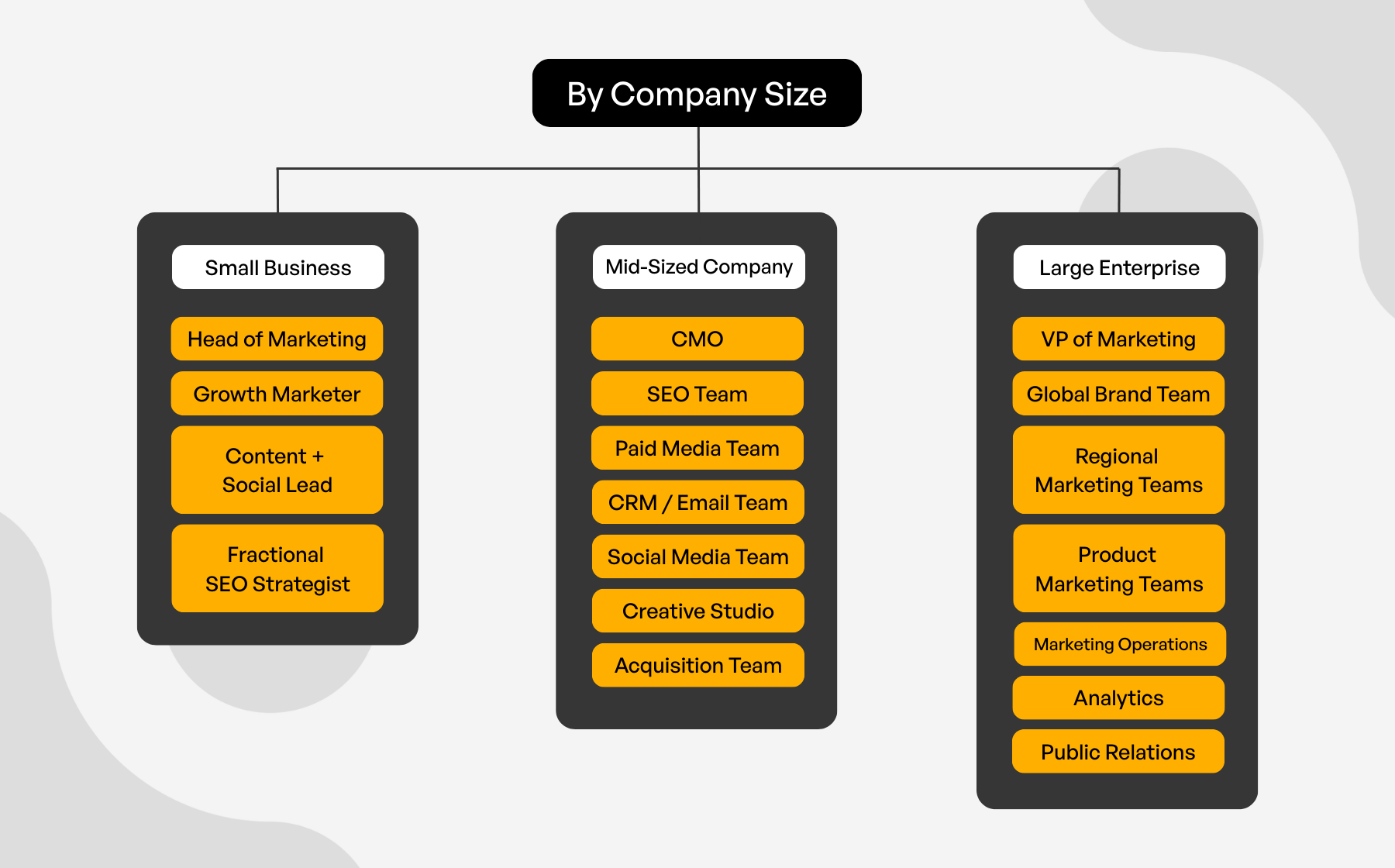
By Company Size
Small Business (1–10 marketing roles)
Structure: Flat / Hybrid
Marketing Manager or Head of Marketing
Generalist or Growth Marketer
Content + Social Lead
Fractional SEO Strategist or Designer
Goal: Build website traffic, demand, and credibility quickly without heavy overhead. Reality: Everyone wears multiple hats, supporting multiple marketing efforts.
Mid-Sized Company (10–40 marketing roles)
Structure: Functional or Hybrid
Vice President (VP) of Marketing / Chief Marketing Officer (CMO)
SEO Team
Content Team
Paid Media Team
CRM / Email Team
Social Media Team
Creative Studio
Revenue / Acquisition Team
Goal: Specialization improves consistency and output quality. Reality: Teams need clear processes to work smoothly across functions
Goal: Segment and product-level focus increases personalization and market penetration. Reality: Requires advanced systems and leadership to align everyone.
Marketing team structure grows more layered as companies scale
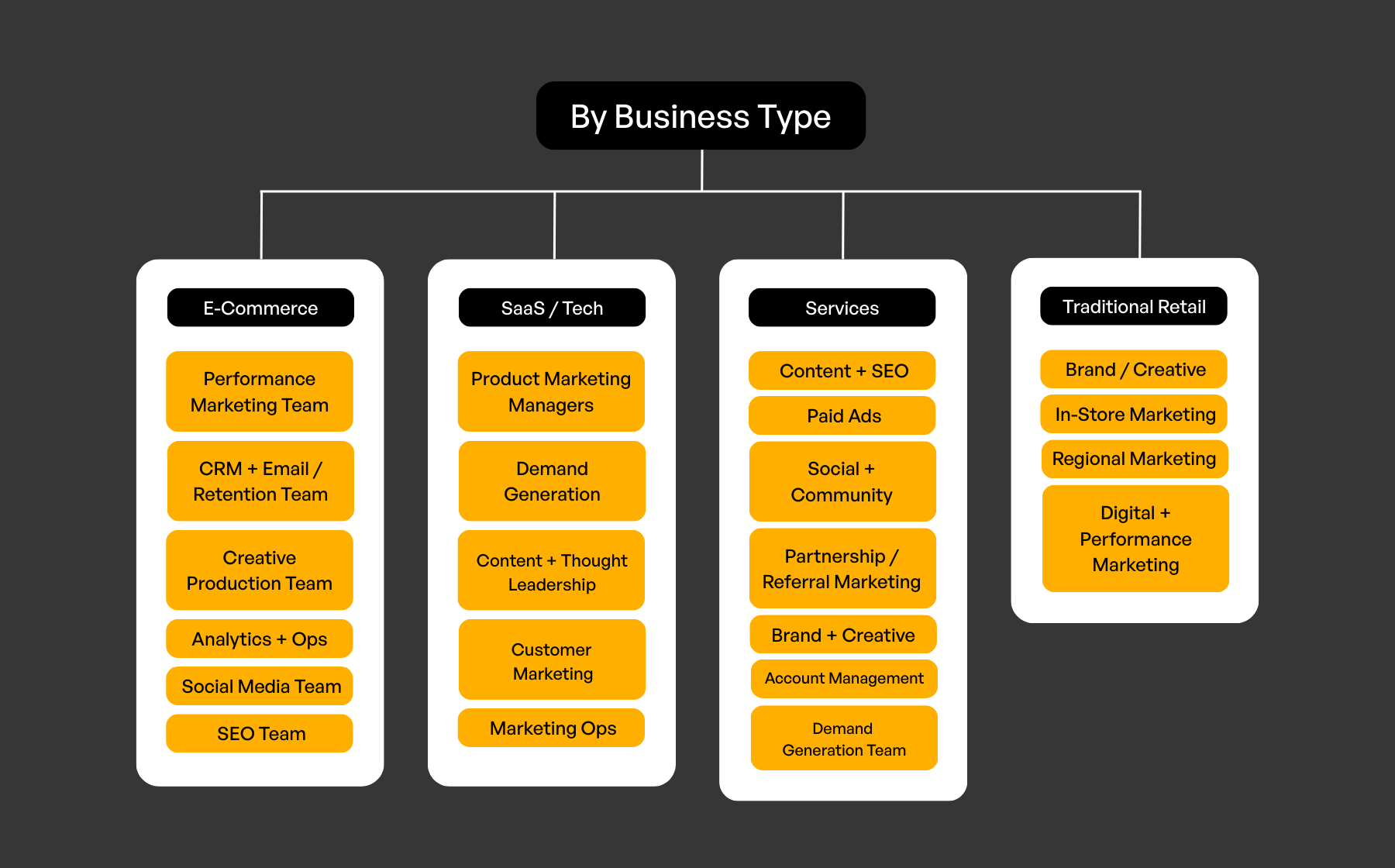
By Business Type
E-Commerce
Focus: Acquisition + retention
Performance Marketing Team (paid ads, conversion rate optimization)
CRM + Email / Retention Team
Creative Production Team
Analytics + Ops
Social Media Team
SEO Team
SaaS / Tech
Focus: Product marketing + lifecycle
Product Marketing Managers (PMMs)
Demand Generation
Content + Thought Leadership
Customer Marketing
Marketing Ops
Services / Agencies
Focus: Reputation + lead generation
Content + SEO
Paid Ads
Social + Community
Partnership / Referral Marketing
Brand + Creative
Account Management + Client Relations Team
Demand Generation Team
Traditional Retail
Focus: Merchandising + local marketing
Brand / Creative
In-Store Marketing
Regional Marketing
Digital + Performance Marketing
Marketing teams look different depending on how a business sells and serves customers
How to Build a Successful Marketing Team
Below are 10 practical steps to build a high-performance marketing team, no matter your size or industry. These steps focus on decisions leaders often struggle with as teams grow, priorities change, and workloads increase.
Start with your business goals, not job titles
Before hiring or restructuring, define:
Revenue targets
Sales cycle
Buyer journey
Product launch plans
Growth channels
Your strategy dictates your structure – not the other way around.
Identify Your Immediate Marketing Priorities
As you are actively building your team, focus on what marketing needs to deliver in the next 3 to 12 months, rather than everything the business may want to achieve long-term.
At this stage, it is more effective to prioritize one or two core channels and commit to them fully instead of spreading budget and people across too many initiatives.
Ask questions such as:
Which channel is most likely to generate results in the near term?
Where has the business already seen early signs of performance?
Which channel can the team realistically support with the resources available today?
Examples of short-term priorities include:
Building demand through one primary acquisition channel
Strengthening SEO and content before expanding paid efforts
Supporting sales with consistent inbound leads
Improving visibility in a single key market or region
These decisions help define what roles you need now and prevent hiring ahead of proven demand.
Clarify the Long-Term Team and Company Vision
Once immediate priorities are clear, take time to define the type of marketing team – and company – you want to build over the long run.
This is less about channels and more about direction.
Consider questions such as:
What kind of working culture do we want within marketing?
Do we value experimentation, consistency, or speed?
How complex do we expect the marketing organization to become?
What level of leadership and structure will be needed as the business grows?
This long-term view helps guide future decisions around leadership roles, team design, and how the marketing function evolves as the company matures.
Assess whether you need generalists, specialists, or a blend
Generalists: Great for early-stage or lean teams
Specialists: Ideal for scale, efficiency, and deep expertise
Blended teams: A generalist leader + specialist pods = best of both worlds
Map out cross-functional collaboration early
Marketing does not exist in a vacuum. Align expectations with:
Sales (lead quality, handoff process)
Product (feature releases, messaging)
Operations (timelines, support)
Leadership (KPIs, reporting cadence)
This prevents miscommunication and chaotic workflows.
Invest in Marketing Operations early – even part-time
Marketing operations supports the foundational work that keeps marketing activities organized, measurable, and consistent. This includes:
Tracking and reporting performance
Maintaining clean and reliable CRM data
Monitoring the full funnel from lead to conversion
Setting up automation and workflows
Coordinating timelines and dependencies across campaigns
For many businesses, this role is difficult to justify as a full-time hire early on, yet the absence of it often leads to unreliable data, fragmented processes, and reactive decision-making.
Using a support layer or marketing support can help cover these operational needs early, with systems and workflows established while the internal team focuses on priority initiatives.
Build processes before scaling headcount
Adding people before defining how work gets done often leads to unnecessary cost and confusion. A principle we emphasize at The Virtual Hub is “don’t throw a body at a problem.” If a task feels overwhelming or slow, the issue is often the process – not the number of people involved.
Before expanding the team, document:
How campaigns are planned and scheduled
How content moves from idea to publication
Who is responsible for each stage of work
Where reviews and approvals happen
What success is measured against
Clear processes help reveal whether additional roles are truly needed or whether existing workflows simply need refinement. Teams that address structure and process first tend to scale more effectively and avoid hiring to compensate for unresolved issues.
Start small, then scale intentionally
Building a marketing team does not require multiple departments from the start. Teams often perform better by adding structure and capability in stages, based on actual demand rather than assumptions.
A staged approach looks like this:
Stage 1: A marketing lead with versatile support covering multiple channels
Stage 2: Specialists added in priority areas such as SEO, content, paid advertising, or design
Stage 3: Team leads introduced to help manage workload and coordination
Stage 4: Growth into functional or hybrid team models
Teams that skip early stages often struggle with inefficiency or underutilized roles. Many organizations address this by exploring marketing support models that allow them to increase execution capacity, validate which channels are worth investing in, and strengthen workflows before adding roles.
Hire leaders who understand both strategy and execution
Your first hire or highest-level leader shouldn’t only think or only do – they need to do both until you scale.
Look for:
Strategic thinking
Hands-on capability
Operational discipline
Analytical mindset
Leadership and coaching ability
Bad leadership is a structural failure.
Set clear KPIs for every role and every channel
Each marketing role should be measured using indicators that show what progress looks like in practical terms. These examples focus on what teams can easily observe, count, or compare over time.
SEO
Increase in the number of people visiting the website from Google or other search engines
More website pages appearing near the top of Google search results
Growth in visits to important pages such as product or service pages
Content
Number of people reading blog posts, guides, or landing pages
How many readers take action, such as filling out a form or signing up
Signs that people are actually reading, such as scrolling, comments, or shares
Paid Advertising
Amount spent to get one lead or inquiry
Number of leads that are suitable for follow-up by the sales team
Sales or inquiries that can be traced back to paid campaigns
Email / CRM
How many recipients open emails and click links
Number of returning customers or reactivated contacts
Sales or inquiries generated from email campaigns
Social Media
Growth in followers who match your target audience
Level of interaction with posts, such as likes, comments, and shares
Number of people who click from social media posts to your website
Using well-defined metrics like these helps teams evaluate progress objectively and ensures performance discussions are based on data rather than assumptions.
Review and refine your team structure every quarter
Marketing evolves fast, so team setup should be reviewed regularly rather than treated as a one-time decision. A quarterly review gives leaders a chance to see what is working in practice and what needs adjustment.
During each review, look at the following areas:
Anything slowing the team down:
For example, long approval cycles, repeated revisions between teams, or campaigns waiting on one person who has too many responsibilities.
New skill gaps:
Examples include no one owning analytics and reporting, limited experience with paid advertising as spend increases, or a lack of product knowledge during new launches.
Redundant roles or overlapping responsibilities:
This might show up as two people managing the same channel, duplicated reporting, or multiple teams creating similar content for the same audience.
New opportunities the team wasn’t built for:
Examples include entering a new geographic market, launching an additional product, expanding into video or partnerships, or supporting a new sales motion.
Collaboration challenges:
Look for recurring issues such as unclear responsibilities between marketing and sales, missed follow-ups on leads, or confusion over who owns campaign coordination.
Regular reviews like these help ensure the team setup continues to support current priorities rather than holding the business back as it grows.
Great marketing teams organize work before assigning roles
The Virtual Hub Approach to Marketing Team Structure
Traditional marketing team structures are typically designed around roles – SEO specialists, paid ads managers, content leads, designers – each responsible for a defined function. While this approach is widely used, it often leads to highly skilled, strategic roles spending a significant portion of their time on repetitive or execution-heavy tasks.
At The Virtual Hub, we approach marketing team structure from a different starting point: the work itself.
Instead of asking, “Which roles do we need to hire?” we ask:
What tasks need to be done consistently?
Which activities require strategic decision-making versus reliable execution?
Where is high-value time being consumed by low-leverage work?
Tasks First, Roles Second
In many marketing teams, strategic leaders end up managing reports, coordinating timelines, maintaining systems, and handling day-to-day execution alongside their planning responsibilities. Over time, this reduces focus, slows decision-making, and increases cost without improving output.
Our model separates marketing work into two distinct layers:
Strategic Layer: Responsible for direction-setting, prioritization, channel strategy, messaging, performance review, and decision-making.
Execution Layer (Support Layer): Responsible for consistent task delivery – campaign setup, content publishing, CRM updates, reporting preparation, and coordination.
This structure allows strategic roles to stay focused on planning and optimization, while the execution layer handles the volume and repetition required to keep marketing activities moving forward.
Why This Structure Is Different
Organizing teams around tasks rather than stacking specialized roles leads to:
More efficient use of senior talent time
Greater consistency across marketing activities
Clear visibility into what work actually requires support
Flexibility as priorities and channels change
Most importantly, it avoids a common inefficiency: hiring for expertise when the real constraint is execution capacity.
Conclusion: How Effective Marketing Team Structure Supports Business Goals
Marketing team structure influences how work flows across roles and priorities. Teams that revisit their setup as the business evolves are better positioned to support growth, manage complexity, and adapt to new demands without unnecessary disruption.
Rather than selecting a template at random, look at what your business is trying to achieve, who you are serving, and which marketing channels you rely on most, and use that information to decide how your team should be organized.
If you want to optimize or redesign your marketing team structure, or build a scalable system that grows with your business – book a call with us. We’ll help you create a structure that supports your next stage of growth.
Masterclass: Optimize your people strategy for growth