The newest hybrid work productivity statistics show hybrid teams can match – and often beat – traditional office performance.
For instance, a 2024 study found that when workers moved to a hybrid schedule, resignations dropped by 33% compared to those on full-time office schedules.
Here are 30 recent hybrid work productivity statistics that show when hybrid is done well, it can boost output, focus, engagement, and retention.
Thinking about adopting hybrid work for your organization? We can help you make it work effectively.
Hybrid work helps employees start the day energized and focused, leading to more productive work hours.
Hybrid Work Output and Performance Statistics
Organizations that adopt hybrid models are seeing fewer workflow disruptions and stronger day-to-day execution.
1. Employees reported an average productivity increase of 19% under their latest hybrid arrangements – equivalent to gaining an extra 7.6 hours of productive work each week, nearly a full additional workday. (Cisco)
2. In a 2024 workplace health analysis, hybrid workers lose the fewest productive days per year (47.8 days) due to health issues – fewer than office-based workers (49.0 days). (Corporate Adviser)
3. Sixty-six percent of managers report higher team productivity under hybrid/remote models. (FlexOS)
4. Hybrid workers have 4.9 days of formal absence per year – the lowest across all working arrangements. (Corporate Adviser)
5. A 2025 global workforce report found that 50% of high performers work for organizations requiring fewer than three days in the office per week. (Cisco)
6. A 2024 survey on workplace accessibility showed that 15–20% of workers are neurodivergent, and the most beneficial adjustment for them is greater flexibility in schedule and work location, making hybrid work a naturally supportive model for diverse cognitive needs. (IWG)
Hybrid Work Statistics on Engagement, Preference, and Satisfaction
Teams operating in hybrid environments report stronger motivation and a deeper sense of involvement.
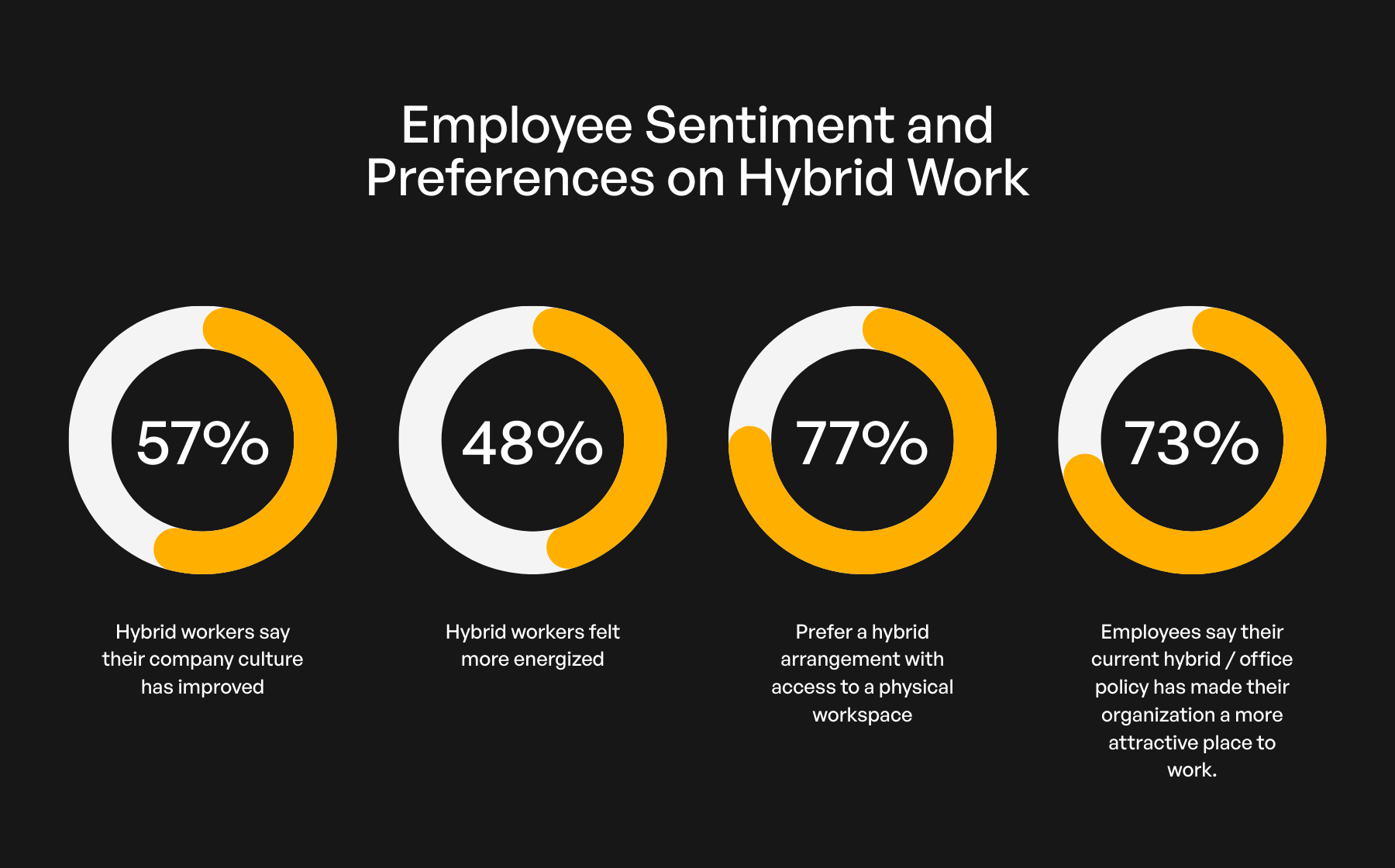
7. Remote and hybrid workers are 57% more likely than office-only workers to say their company culture has improved, citing flexible work policies as the #1 driver. (Future Forum)
8. Forty-eight percent of hybrid and remote employees felt more energized – indicating hybrid models support sustained performance, not just short-term output. (Buffer)
9. Sixty-seven percent of workers prefer a hybrid arrangement with access to a physical workspace. (Future Forum)
10. Flexible workers are equally or more likely than office workers to feel connected to their team, their manager, and company values. (Future Forum)
11. Employee sentiment is most positive when policies are fully flexible (74% positive sentiment) or mandate a set number of days but allow employees to select which days (71% positive). (Cisco)
12. Seventy-three percent of employees say their current hybrid / office policy has made their organization a more attractive place to work. (Cisco)
Employees in hybrid settings report stronger culture, higher energy, and greater satisfaction with their work experience.
13. In a 2024 workforce study, 22% of hybrid and remote workers say they would expect a salary increase if they were required to return to the office full-time. (Owl Labs)
15. Fifty-nine percent of working mothers want to work 3–5 days outside the office, compared to 47% of working fathers. (Future Forum)
16. Hybrid roles represented 38.3% of all UK job postings and 29.7% of France’s job postings, demonstrating strong employee and employer preference for blended work. (LinkedIn)
17. Hybrid remained the most in-demand workplace type across the U.S., UK, Germany, France, and India throughout 2024, consistently outpacing fully onsite listings. (LinkedIn)
18. A recent CEO survey found that three-quarters of business leaders expect their companies to still operate in a hybrid model five years from now, signaling confidence in its long-term productivity benefits. (IWG)
Hybrid Work Statistics on Well-Being
Healthier employees are more consistent and focused – and hybrid models support habits, routines, and conditions that reduce stress and strengthen overall stamina at work.
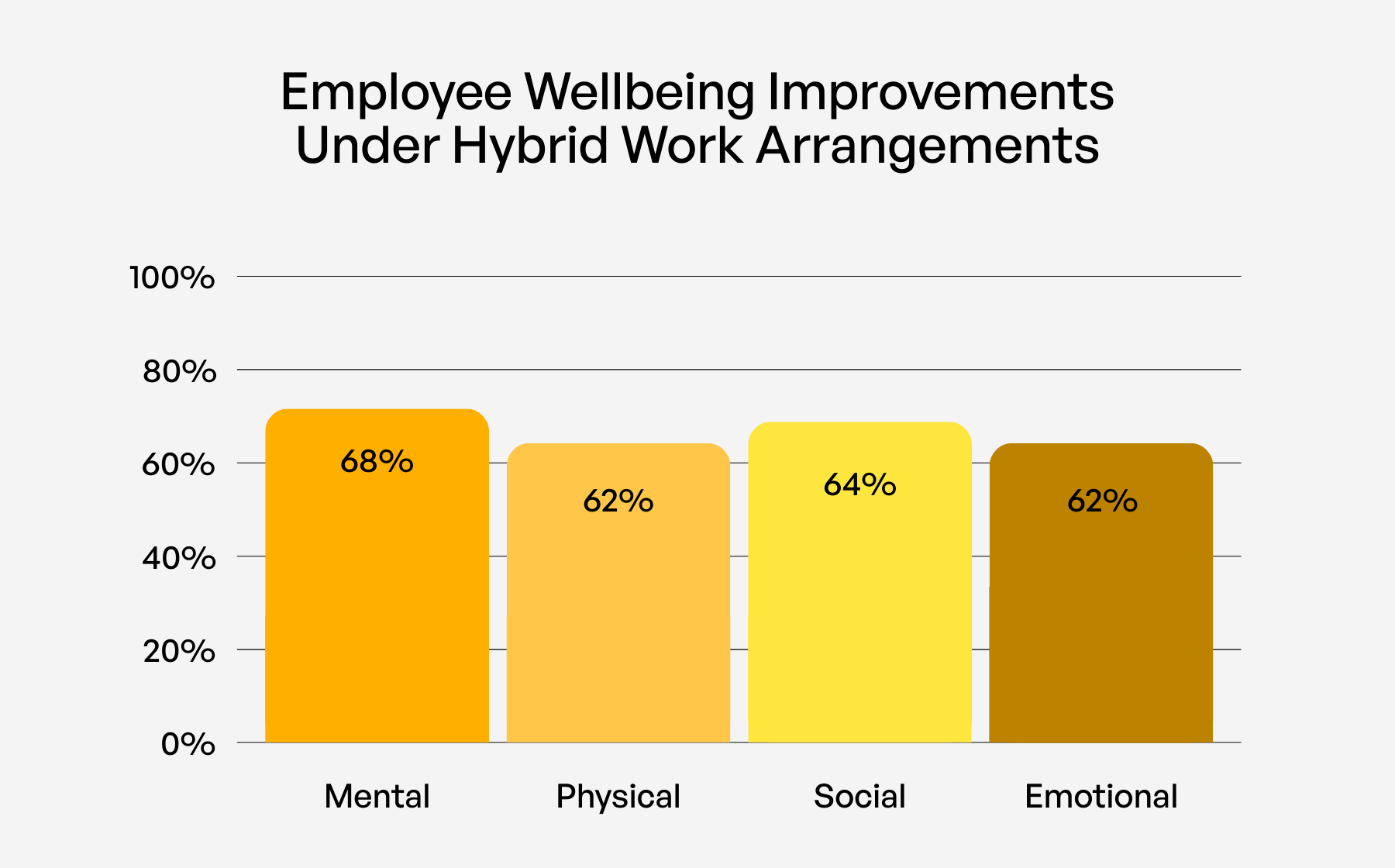
19. Hybrid work has strengthened overall wellbeing, with employees reporting improvements across mental (68%), physical (62%), social (64%), and emotional (62%) health under their current hybrid arrangements. (Cisco)
Hybrid work supports healthier routines across wellbeing, enabling more consistent performance.
20. Hybrid workers get 71 additional hours of sleep per year. (IWG)
21. Hybrid workers exercise almost 90 minutes more per week, which has contributed to notable weight loss – with almost one quarter losing 20 pounds or more. (IWG)
22. Fifty-four percent of hybrid workers have more time to cook healthy meals. (IWG)
23. Around 46% of hybrid workers manage to consume the recommended five portions of fruits and vegetables per day – showing that hybrid employees tend to maintain healthier dietary habits. (Corporate Adviser)
24. Sixty-one percent say they experience less burnout, indicating hybrid is often the healthiest path to high performance. (Amply)
25. Just 8.1% of hybrid workers are at risk of depression. (Corporate Adviser)
26. Over 80% of employees who have worked hybrid want to keep that arrangement because it helps them maintain better balance. (McKinsey)
27. For parents, hybrid work eases family pressure – 38% say the ability to work closer to home is the primary factor reducing childcare stress, rising to 49% for parents of children under five. (IWG)
Hybrid Work Productivity Through Retention
Lower turnover preserves team expertise, reduces hiring delays, and keeps critical knowledge inside the organization – ultimately safeguarding long-term productivity.
28. Sixty-nine percent of employers said hybrid policies improved retention, with organizations experiencing an average retention boost of 34% after implementing more flexible work arrangements. (Cisco)
29. Companies that required just one day in the office per week saw retention rise by 41% on average. (Cisco)
30. Seventy-one percent of millennials and 77% of Gen Z who currently work from home or in hybrid models would look for a new job if forced back to a full-time office schedule. (Deloitte)
The Bottom Line About Hybrid Work
Across every major indicator – output, well-being, engagement, and retention – hybrid work consistently delivers measurable benefits for both employees and organizations.
The data shows a clear pattern: when structured thoughtfully, hybrid arrangements create the conditions for people to perform at their best.
Hybrid is not simply a modern preference – it is increasingly a competitive advantage.
If you’re exploring how to implement a hybrid structure that actually improves performance, book a call with us and let’s build the right setup for your organization.
Masterclass: Optimize your people strategy for growth