Virtual Assistant Cost: The Real Numbers, Models, and ROI Explained
- The Virtual Hub Marketing
The cost of a virtual assistant (VA) can range from USD $500 to $10,000 per month.
That’s a crazy wild range! So obviously, there’s a lot more to understand about the cost story.
Let’s break it down so you can get the right information to make the right decision for your assistant needs.
Ready to explore your options? Explore here to learn more.
Key Factors That Influence Virtual Assistant Cost
The wide price range (USD $500–$10,000/month) for virtual assistants becomes far easier to understand once you look at all the factors that shape the cost.
These factors explain why two “VAs” can be priced worlds apart – and why understanding your true needs and choosing the right setup matters just as much as choosing the right person.
1. Location
One of the biggest drivers of virtual assistant cost differentials is geography. The same skillset can vary in cost depending on where in the world the talent comes from.
Broadly, the market breaks down into three areas:
- Philippines, Vietnam, India → Lower-cost, high-availability talent markets
Direct freelance contractors: USD $3–$12 per hour / USD $500–$2,000 per month
Agency: USD $1,500–$5,000 per month (for fulltime) - Eastern Europe, South Africa, South America → Mid-range pricing
- United States or Australia → USD $3,000–$5,000/month for direct hires, even without agency support
Agency: USD $5,000–$12,000 per month( for fulltime)
This disparity is also why many business owners gravitate toward fully managed providers in Southeast Asia. They combine skilled talent with structured support at a far lower cost than hiring directly in Western markets.
2. The Operating Model
Another key factor that drives the cost differential is the operating model behind how the service is delivered.
VA providers might look the same, but one might be offering simple recruitment only or recruitment plus light management of individual assistants, while the other might be offering a full operational engine behind the assistants.
The more structure and support built into the model, the higher the cost – and the lighter your workload becomes.
3. Type of Engagement
Your workload and availability requirements directly affect pricing.
- Project-based work → Best suited for freelance contractors
- Part-time roles → Offered by a small number of agencies or freelance contractors
- Full-time, long-term support → Best sustained through managed-service providers or Business Process Outsourcing (BPO) with local entities for necessary employment compliance
4. Role Complexity
Cost increases as the skill level and specialization required increase.
Higher-cost roles often involve:
- CRM, automation, or systems work
- Technical and data-heavy responsibilities
- Funnel building, marketing operations, or multi-platform support
These roles require stronger candidate screening, more in-depth onboarding, and ongoing upskilling – all of which raise the overall cost.
Many founders assume all “VAs” are interchangeable, but mismatching the role to the required level of expertise is one of the most common reasons VA placements fail.
The Three VA Models and What They Cost - Plus the Pros and Cons of Each
Most business owners look at virtual assistant pricing as if it’s one category with different price tags. But the VA industry isn’t a single lane – it’s a three lane spectrum, and each model comes with a completely different level of support, risk, and infrastructure.
Here is the breakdown of how the industry actually works, not how it’s usually marketed.
VA Model 1: Direct Hire or Freelancer
A direct-hire VA or freelancer is a virtual assistant you recruit and manage on your own, without any company or team supporting them.
This is the pure DIY route. You hire via platforms like Upwork, Fiverr, OnlineJobs.ph, or sometimes pay a one-time recruiter fee.
Your responsibilities in this model:
- Screening resumes
- Interviewing and testing candidates
- Training
- Documenting your own processes
- Setting up equipment or expecting them to provide their own
- Monitoring day-to-day performance
- Managing payroll, sending international payments, and ensuring compliance
- Replacing them if they move on
Pros:
- Lowest upfront cost
- Flexible and fast to engage
- Ideal if your business already has strong Standard Operating Procedures (SOPs) and management systems
- Good for project-based or short-term work
- Ability to pay purely per hour
- No obligation to provide healthcare and government-mandated benefits
Cons:
- Legal exposure: You’re contracting someone in another jurisdiction. NDAs usually carry no enforceable weight.
- Security risks: You’re handing over inbox access, client data, and logins to a contractor with no legal recourse.
- Instability: If they disappear, the work falls back on you instantly.
- Heavy emotional load: Every hire, every resignation, every performance issue hits you directly.
- Time drain: You become the HR, trainer, manager, and compliance officer.
Typical cost:
USD $3–$65/hour
Best for:
Owners who don’t mind taking on the operational, managerial, legal and compliance responsibilities that come with direct freelance engagements.
Value consideration:
On paper, this often looks like the cheapest option – but that calculation changes once you account for the hours you personally spend recruiting, negotiating contracts, training and performance managing, or covering gaps and hiring again if it fails.
That lost time is the opportunity cost most business owners overlook. It’s the silent expense that turns an acceptable hourly rate into a potentially expensive exercise overall. The real cost isn’t the VA’s fee, but the revenue-producing work you postpone every time you have to step back into the trenches.
VA Model 2: Managed Service Providers
A managed-service VA is a virtual assistant employed, supported, and managed by a third-party company – giving you stability without having to build your own HR, training, or compliance infrastructure.
This is the model that has the widest breadth of options but is possibly the least understood because of that breadth.
Instead of engaging isolated freelance labor, you’re gaining access to an ecosystem behind the person – an internal team that can stretch from basic employment legal / compliance to full ecosystems of support from recruiting right through to training and scalability (and everything in between).
The Two Types of Managed Service Providers:
Employer of Record (EOR)
An Employer of Record / EOR legally employs your VA in their home country while you remain fully responsible for recruitment and managing their day-to-day work.
The EOR’s role is strictly administrative and compliance-focused – they are the legal employer on paper, but you run everything operational.
What the EOR covers:
- Employment contracts
- Payroll and taxes
- Labor law compliance
- Government-mandated benefits
- Compliance-level HR administration
What remains your responsibility:
- Recruitment and selection
- Onboarding
- Training
- Daily management
- Performance accountability
- Replacement if the hire doesn’t work out
Pros:
- Lower legal and compliance risk
- Correct employment classification
- No need to set up a local entity
- Payroll and government obligations handled for you
- More stability than freelance contractors
Cons:
- No recruitment support
- No training support
- No performance management system
- No structured replacement process
- Operational responsibility stays on your plate
Typical cost:
USD $200–$2,000+/month per hire
Best for:
Business owners who want the legal protection and compliance structure of a formal employer while maintaining all other elements of the process themselves.
This model is also ideal for companies that already have internal systems for training, oversight, and performance management, and simply need a compliant way to hire and pay an employee in a jurisdiction where they do not have a legal entity.
Value consideration:
An EOR gives you legal, compliance and administrative certainty, which removes the risk and complexity of hiring in another country.
Fully Managed VA Providers
These are companies that not only legally employ the VAs in their resident country but also recruit, train, support, manage, and oversee them continuously.
Instead of hiring a single worker, you’re partnering with an organization that builds a full-suite support system around the VA or VA team – so the person integrates into your business smoothly and stays functional long-term.
A fully managed provider, like The Virtual Hub, handles the parts of management most business owners don’t have time or even desire to deal with.
Support you receive in this model:
- Recruiting and vetting
- Employment contracts and compliance
- Payroll, benefits, and private healthcare
- Performance management and coaching
- HR support and documentation
- Client success management
- Cybersecurity, data protection, and access control
- Structured onboarding and integration
- Equipment, office space, or hybrid setups
- Replacement in case of resignations
- Cultural alignment and communication support
Pros:
- Most stable VA model
- Much lower turnover
- Predictable output
- Built-in training and role-specific upskilling
- Ability to create customized training paths based on the client’s tools and workflows
- Strong data privacy and cybersecurity controls
- Hands-off operational load
- Efficient replacements when needed
- Easy monthly subscription billing (holiday pay, overtime, night differential, government requirements, payroll, and employer obligations handled internally)
- Access to the “machine behind the person” – recruitment, training, HR, compliance, client success, and operational support that keeps the VA performing well
Cons:
- More expensive than hiring a freelancer
- Less control over HR processes
- Not ideal for project-only work or ultra-short engagements
Typical cost:
USD $1,000 to $10,000 per month with location playing a large role in the range.
Insight!
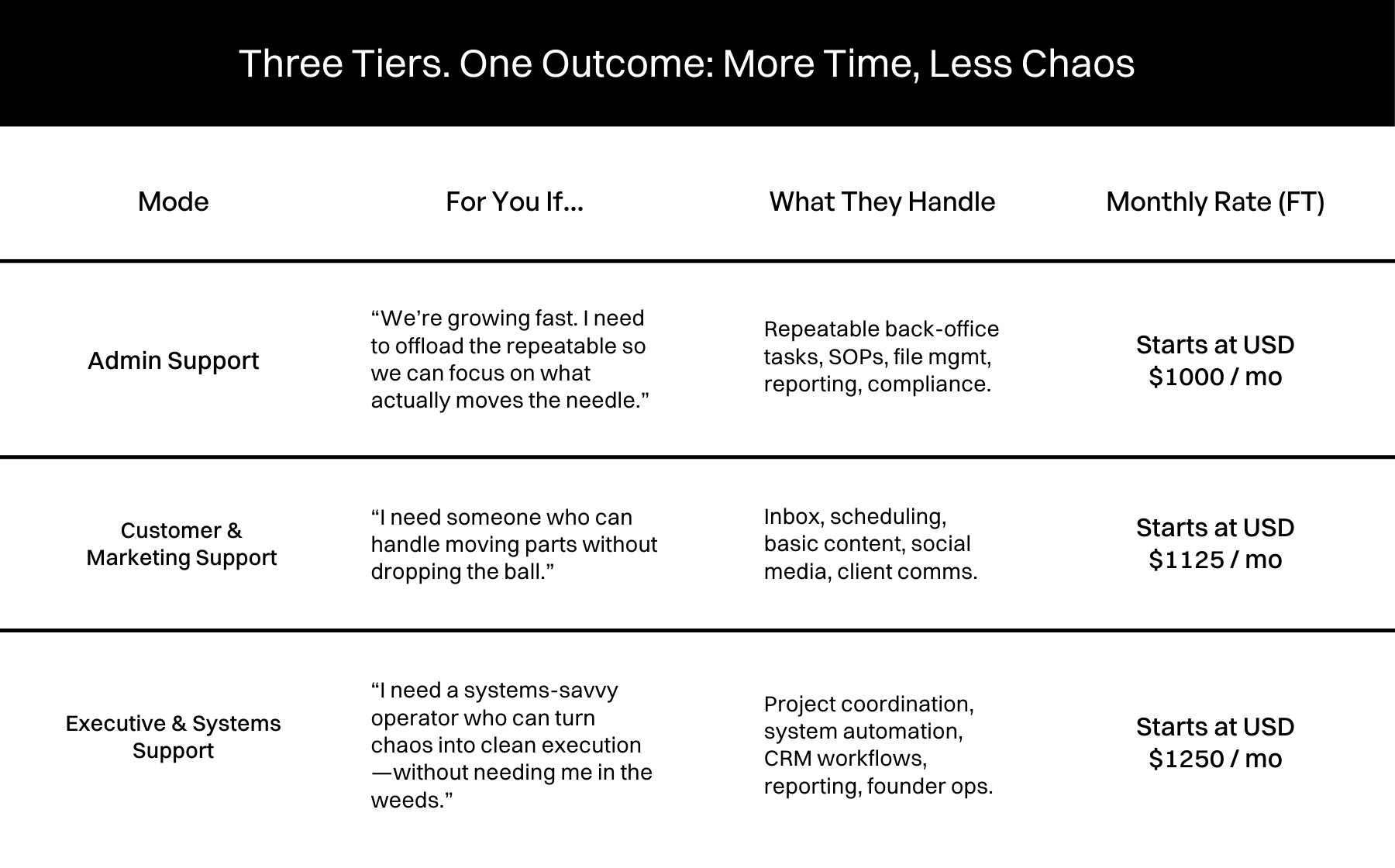
The Virtual Hub price range is from $1,500 to $3,000 per person per month.
We also do part time. Let’s chat!
Insight!
The Virtual Hub price range is from $1,500 to $3,000 per person per month.
We also do part time. Let’s chat!
Best for:
Business owners and companies who want plug-and-play reliability – not trial-and-error hiring – without building their own internal HR and training operations.
Value consideration:
Here, you’re investing in the operational engine behind the VA. The financial value comes from time reclaimed, continuity secured, and problems prevented, not just labor performed.
For many businesses, this simple to use, stable and scalable model allows teams to focus more on growth and so achieves the highest-value return on the investment.
“Our Elite Assistant has been a true game-changer
for our team.”
She’s detail-oriented, manages tasks with precision,
and communicates proactively. Her ability to collaborate across global teams and take on challenges with a positive attitude makes her truly invaluable.
— Tony Do | Senior Marketing Manager at HubSpot
VA Model 3: Full Business Process Outsourcing
This model sits at the far end of the VA spectrum. Instead of giving you a dedicated assistant who becomes part of your team and integrates into your business systems, a Business Process Outsourcer / BPO takes over an entire function and completes the work inside their own operation.
You are not hiring a single VA. You are outsourcing work to a company with its own staff, systems, and management layers to be done inside of their business and sent back out to yours.
Operational process in this setup:
- You send tasks or processes into the BPO.
- The provider assigns those tasks to members of their internal workforce.
- The completed work is returned to you through an agreed reporting or delivery system.
You don’t choose the individual doing the work, and you typically don’t communicate with them directly. If someone in their team is sick or on leave, someone else in the pool picks it up – you just see the completed output.
Elements of this model:
- Teams of people
- Supervisors, team leads, and quality assurance
- 24/7 or multi-shift coverage
- Enterprise-level data security and access controls
- Internal training departments
- Detailed reporting and documentation
Pros:
- Highest level of structure and operational depth
- Best for scale and high-volume work
- Least risk in terms of continuity
- Advanced security and compliance
- Multi-layer management
- Full-function outsourcing (not just a single role)
Cons:
- Highest cost
- Less flexibility for personalized workflows
- Designed for enterprise needs, not solo founders or small teams
- Long-term contracts are common
Typical cost:
Varies widely and depends on type of work, process development level, location, coverage, security level and many other factors.
Best for:
Organizations that need an entire function handled end-to-end, like a call center operation as an example. This suits large, process-heavy operations that require volume output, strict compliance, multi-person coverage, and enterprise-level reporting.
Value consideration:
The value here comes from operational firepower, not cost savings. A BPO gives you the ability to process large volumes of work consistently, without building teams, managing staffing issues, or maintaining internal oversight.
Instead of scaling your own operations, you tap into an existing system that already has training pipelines and role coverage in place.

The Bottom Line About Virtual Assistant Cost
The question, “How much does a virtual assistant cost?” only scratches the surface. A more useful question is: “What are you investing in?”
A single pair of hands?
A service that lightens your workload?
A system that shields you from turnover, risk, and disruption?
A long-term operations partner who strengthens the backbone of your business?
Understanding the full spectrum of VA models makes the pricing finally make sense. Cost becomes less about the monthly figure and more about the level of support, stability, and infrastructure you want working in the background of your business.
You’re not choosing a price point – you’re choosing an operating model. And the right model removes work you shouldn’t be carrying yourself.
Ready to choose the setup that fits your business goals? Book a call with us today.
Masterclass:
Optimize your people
strategy for growth
Watch Now!
Want to talk to
our team?
Discover more strategies to scale smarter with people optimization
Join our scaling smarter community